The Incredible Shrinking Dollar
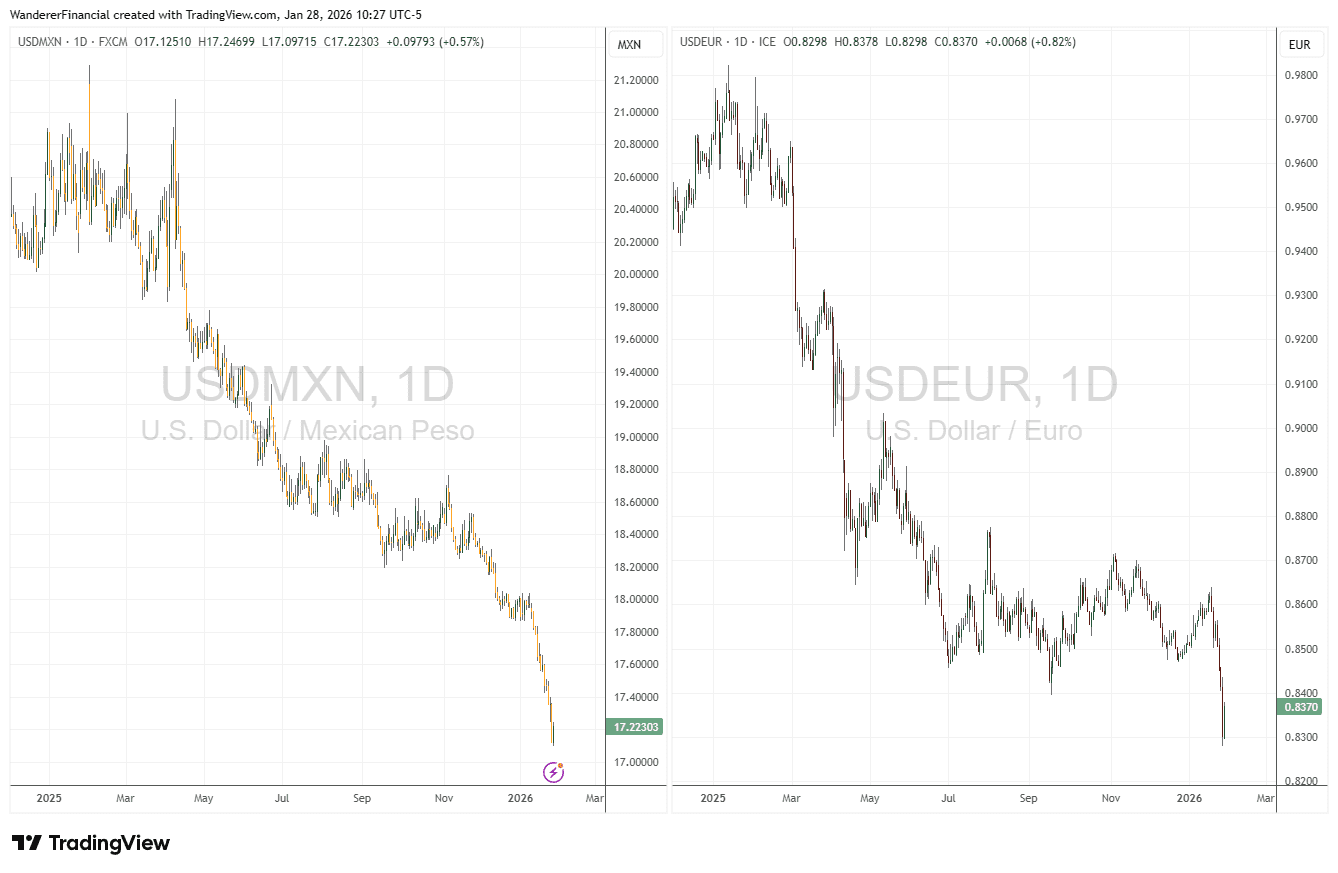
For decades, the U.S. Dollar (USD) has been the undisputed heavyweight champion of the world. But recently, this measuring stick of world wealth has begun to crack. A crashing USD isn't just a line on a chart, it is a fundamental shift in how much your hard-earned money can actually buy.
President Trump has always been a strong proponent of a weak dollar. We saw this during his first presidency, when the USD lost ~10% of its value. Over the next four years under Biden the USD rose ~20% again. Now, since taking office a second time, Trump has seen the value of the USD freefall 15%. The argument for a weak USD is rather simple. A weak dollar makes U.S. products cheaper. It allows Canada, Mexico, and China (the top three) to buy more U.S. products for less money. This, in theory at least, boosts U.S. manufacturing. It also assumes that those countries actually want more product and that price had been the only reason they weren’t buying more to begin with.
Perhaps surprisingly, despite our weakening dollar, manufacturing exports have actually been decreasing. October 2025 data showed a record month for U.S. exports, but when the overall number was stripped down it showed that virtually all of the increase was due to foreign buyers scooping up gold reserves from U.S. sellers. Most people would consider this a red flag. Rather than buying USD and U.S. goods, the world is buying gold and other precious metals. To be clear, the U.S. is a net importer of these metals themselves, they aren’t suddenly pulling this metal out of the ground to sell for profit.
So, how does a weak USD affect you? Well, it depends. Are you an average American or are you a rich American? It matters, because a falling dollar creates a pretty clear divide between the two.
The average American feels the sting at the grocery store and the gas pump. Because the dollar is weaker, it takes more of them to buy oil, electronics, and imported food. This is called imported inflation. If you are average, living on a fixed salary with dollar-denominated expenses, your standard of living effectively drops because everything we buy from overseas cost us more in real USD.
If you are a rich American, you likely hold “real assets” like international stocks, gold, and foreign real estate. When the dollar falls, the value of these assets climb in dollar terms. In addition, you likely hold a lot of stock in large U.S. corporations. The sort of companies that love a weak dollar because it makes their products cheaper for foreigners to buy, boosting their overseas profits. Think companies like Apple (54% of sales are outside the U.S.), Coke (61%), and Ford (35%).
"A crashing dollar is a hidden tax on the majority of Americans."
A crashing dollar is a hidden tax on the majority of Americans. A few might benefit because their manufacturing plant job gets a boost in orders, increasing profit for the company, which hopefully trickles down to an increase in wages (but that’s a blog post for another day).
At the end of the day, a weak dollar makes everyday life more expensive for most of us, while inflating the nominal wealth of the assets owned by the elite.
What causes the dollar to weaken? A weak dollar generally indicates the world looking for alternatives. As trust in the U.S. declines, investment in USD via bonds decreases and the world’s money looks for alternatives.
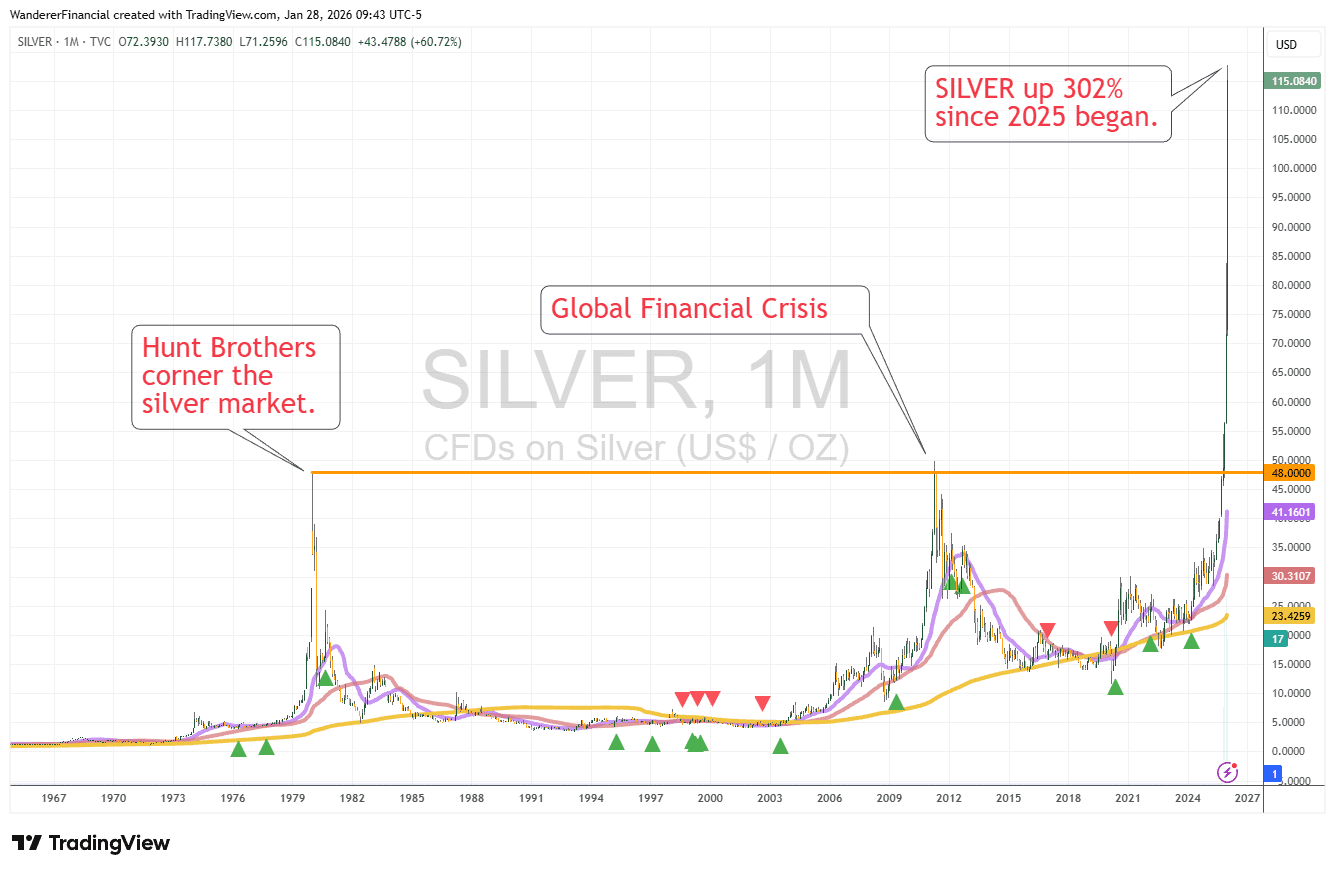
We’re seeing this play out in real time right now as Gold and Silver prices, since the start of 2025, have gone parabolic. Gold is up 101% since Jan. 1, 2025 while Silver is up a staggering 302%.
As trust in paper currency erodes, investors flee to assets with intrinsic value. It’s a bit of a self-sustaining prophecy. Investors think the U.S. Dollar will continue to collapse, which causes them to buy silver and gold instead, which means less demand for USD, which means it falls further, and on and on it goes.
Take your pick of what causes this lack of faith in the USD. Ballooning U.S. deficits, trade wars, shifting alliances, Federal Reserve independence uncertainty, etc.. It really doesn’t matter what is causing it. Once it begins it becomes hard to stop because of that feedback loop.
Only time will tell if this is just another historical blip before things return to what the U.S. has long considered normal (U.S. leads, world follows) or if a more structural collapse is happening that will last decades as a new world leader emerges.
The dollar's decline isn't just an abstract economic event, it’s a direct signal of a shifting world order. As the feedback loop of debt, deficits, and distrust continues to spin, the average American is being handed the bill, while the richest watch their hard assets inflate. Whether this is a temporary correction or a structural collapse remains to be seen, but right now the goldmine is crushing the printing press.
Keep Up With the Wanderer Crew No Matter Where We Are

A decade ago, the idea of managing a global portfolio from a boat in a remote bay was a pipe dream—usually sidelined by a dropped connection or a dead battery. Today, it’s our daily reality. Whether it’s finding a signal in the middle of an archipelago or tracking the dollar's latest freefall from a sun-drenched deck, the goal remains the same: total self-dependence. It’s not always a "vacation," but it is a life on our own terms. No matter where the wind takes us, we’re still looking for the same setups and protecting the same capital. We're just doing it with an ever changing view, the Wanderer Way.
Ready to Learn & Explore More?
Ready to Navigate the New Economic Landscape?
The "Shrinking Dollar" isn't just an economic theory—it’s a shift that requires a new playbook for protecting your lifestyle. At Wanderer Financial, we don’t just track the decline; we actively hunt for the "real assets" that thrive while the dollar fades.
Stop guessing and start following a proven path. Join hundreds of fellow Wanderers who are already using our real-time strategies to build a self-dependent, "pre-tired" life.
What’s Included in Your Annual Membership:
-
Daily Access to Basecamp – Join us and our private community every day to discuss live trade setups, ask questions, and share insights.
-
52 Weekly Market Newsletters – Direct analysis on the trends that actually move the needle, delivered every Sunday.
-
Real-Time Trade Alerts – Immediate notification when we enter or exit positions like Gold, Silver, or China ETFs.
-
Member’s University – Full access to our beginner-to-advanced curriculum on technical analysis, risk management, and trading psychology.
-
Stock-to-Watch – A weekly email highlighting a current trade setup according to our Wanderer Trade Guidelines.
- & More – From easy on-boarding via Wanderer 101 to more in-depth instruction in Wanderer University, we've cover all the bases.